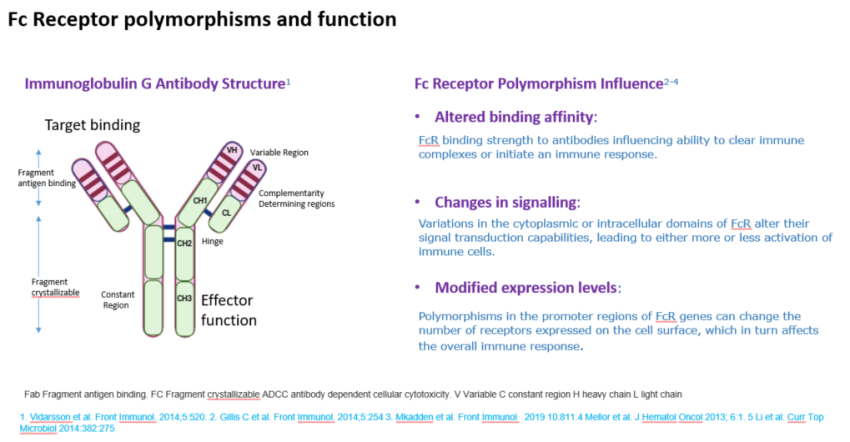

Fc is the effector end of antibodies the Fab binds to the target. Antibodies kill their targets by cells or other molecules pulling holes in the target via the Fc receptor. Natalizumab works by the front end blocking the target for natalizumab. In terms of killing targets by cells there are genetic variants of the Fc receptors that influence function notably in Fc receptor gamma two A and gamma three A of IgG can influence killing by IgG1 but natalizumab is an IgG4 and it doesn’t really kill cells. There are 5 different Fc recptors for IgG. At FCGR2A the 131 His (Histidine) variant (AA genotype) has a higher binding affinity for human IgG1 and, specifically, IgG2 antibodies compared to the FCGR2A-131 Argenine (R) variant (GG genotype). In FCGR3A the valine variant has higher affinity for IgG1 and IgG3 and is less common than the phenylanaline (F) variant.

IgG4 binds to FcγRI, FcγRIIA, IIB and IIC and FcγRIIIAV158.
So this is one of the causes of failure of natalizumab but I suspect that this also links to anti-drug antibodies that occur very frequently in people taking natalizunab. Currently the geneotypes of the FCR receptors are not tested
Cardoso RC, de Matos MD, Duarte LA, Guimenes BD, Pavani GK, Gutman EG, Ferreira HFA, Pereira VCSR, Domingues VB, Farinhas JGD, Fernandez KA, Schmidt FR, Montes GC, Alves-Leon SV, Fontes-Dantas FL. Influence of FCGR2A (rs1801274) and FCGR3A (rs396991) polymorphisms on natalizumab response on multiple sclerosis. Mult Scler Relat Disord. 2025 Dec 6;106:106912. doi: 10.1016/j.msard.2025.106912. Epub ahead of print. PMID: 41385984.
Background: Genetic variants in Fc gamma receptors (FcγRs) have been implicated in the therapeutic failure of monoclonal antibodies. Natalizumab (NTZ), a monoclonal antibody widely used in the treatment of multiple sclerosis (MS), prevents immune cell migration into the central nervous system, thereby reducing inflammation and demyelination. Despite its high efficacy, a subset of patients does not respond to NTZ, with single nucleotide polymorphisms (SNPs) in FcγRs emerging as potential pharmacogenetic biomarkers.
Methods: In this study, we evaluated patients with relapsing-remitting MS diagnosed according to the McDonald criteria and treated with NTZ. Genotyping of FCGR2A (rs1801274 controls variants at position 131/166) and FCGR3A (rs396991 = controlling position 158/179 variants) was performed using TaqMan-PCR allelic discrimination. Cytokine levels were quantified using x-MAP technology.
Results: Of the 116 patients analyzed, 13 were classified as non-responders. (That is 11% failures). Regression adjusted for sex and age revealed that the FCGR2A AG (Adenosine Guanosine) genotype was significantly associated with a reduced risk of therapeutic failure (OR = 0.044; p = 0.014), while for FCGR3A, the AC (Adenosine cytosine) genotype was also associated with a protective effect (OR = 0.077; p = 0.025). No significant effects of age or sex were observed in either model. The FCGR2A rs1801274 GG genotype had weak predictive value for therapeutic failure, whereas FCGR3A rs396991 AA had modest discriminatory power. Additionally, these genotypes were associated with reduced levels of specific pro-inflammatory cytokines.
Conclusion: The FCGR2A-AG and FCGR3A-AC genotypes were associated with a lower risk of NTZ treatment failure, suggesting that FcγR polymorphisms may serve as biomarkers for therapeutic response in MS.
Background: Genetic variants in Fc gamma receptors (FcγRs) have been implicated in the therapeutic failure of monoclonal antibodies. Natalizumab (NTZ), a monoclonal antibody widely used in the treatment of multiple sclerosis (MS), prevents immune cell migration into the central nervous system, thereby reducing inflammation and demyelination. Despite its high efficacy, a subset of patients does not respond to NTZ, with single nucleotide polymorphisms (SNPs) in FcγRs emerging as potential pharmacogenetic biomarkers.
Methods: In this study, we evaluated patients with relapsing-remitting MS diagnosed according to the McDonald criteria and treated with NTZ. Genotyping of FCGR2A (rs1801274) and FCGR3A (rs396991) was performed using TaqMan-PCR allelic discrimination. Cytokine levels were quantified using x-MAP technology.
Results: Of the 116 patients analyzed, 13 were classified as non-responders. Logistic regression adjusted for sex and age revealed that the FCGR2A AG genotype was significantly associated with a reduced risk of therapeutic failure (OR = 0.044; p = 0.014), while for FCGR3A, the AC genotype was also associated with a protective effect (OR = 0.077; p = 0.025). No significant effects of age or sex were observed in either model. Receiver Operating Characteristic (ROC) analysis showed that the FCGR2A rs1801274 GG genotype had weak predictive value for therapeutic failure, whereas FCGR3A rs396991 AA had modest discriminatory power. Additionally, these genotypes were associated with reduced levels of specific pro-inflammatory cytokines.
Conclusion: The FCGR2A AG and FCGR3A AC genotypes were associated with a lower risk of NTZ treatment failure, suggesting that FcγR polymorphisms may serve as biomarkers for therapeutic response in MS.
Source: multiple-sclerosis-research.org