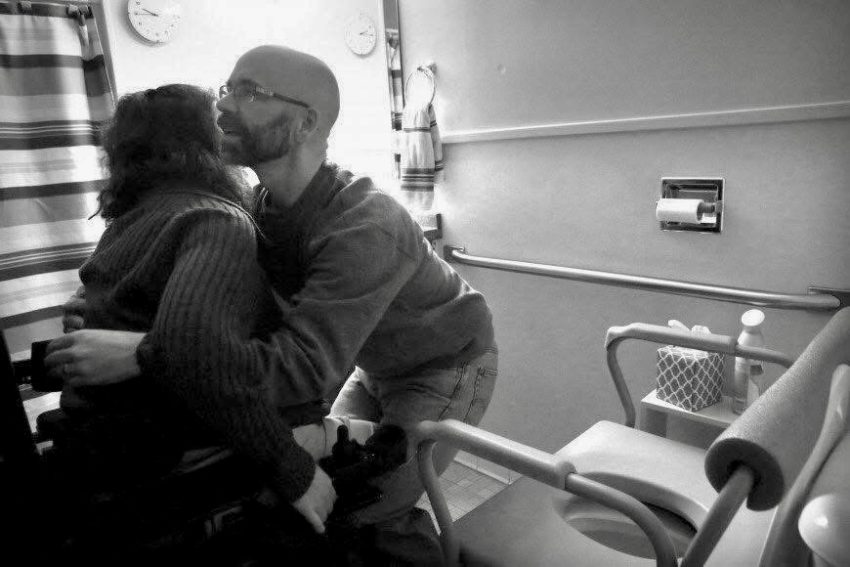
Caregiving couples like Jennifer and me perform a dance every day that no one ever teaches you.
There’s no studio. No choreography sheet. No one calling out the counts. And yet, somehow, we learn the steps through repetition, trust, and a ton of trial and error.

Honestly, it probably deserves a name.
Ballroom and line dances have already claimed words like two-step, pivot, twist, and swing. But caregiving introduces a distinct category of movement born of necessity and shaped by love. Add the word “caregiving” to a few familiar dance steps, and you could build an entirely new dance catalog.
Because what we do isn’t random. It’s practiced. It’s intentional. And for couples navigating disability together, it’s often the most important dance of the day.
For Jennifer and me, that dance is most clearly visible during transfers — those moments when she moves from her power wheelchair to wherever life needs her next.
Here’s how it usually goes:
I line my body up with hers and stagger my stance so we’re balanced. I bend my knees until our eyes meet. I slide my arms beneath hers, link my hands behind her back, and pull us close together. Yes, so close that we can feel each other breathe.
Then I count. “One… two… three.”
On “three,” everything happens at once.
I lift with my legs. Jennifer braces and engages what she can. We hold on tight — for stability, for reassurance, and because this is not the moment to let go.
Once she’s standing and steady, we pivot together toward the next destination: the shower chair, the toilet, the bed, the standing frame. Wherever the day calls for.
Simple? Maybe on paper. But in real life, it takes focus, communication, strength and complete trust. Miss a step and we’re both literally on the floor.
So yes, it’s a dance in every sense of the word.
The Caregiving Slide
Transfers are a core part of many caregiving relationships involving disability. Thankfully, there are tools — Hoyer lifts, standing frames, and transfer devices — designed to make those movements safer. Jennifer and I own them. We’re grateful for them, and we use them when we need to.
Caregiving isn’t a solo performance. It’s a partnership.
But for most of our more than 20 years of marriage, during which we’ve also served as each other’s primary caregivers while both living with MS, we’ve relied on our own choreography.
Let’s call it the “Caregiving Slide.”
This move works for us because it balances efficiency with intention. It enables Jennifer to engage her legs, even briefly, and remain an active participant in her movement. This matters deeply to her.
It matters to me, too.
The Caregiving Slide keeps my legs strong, my back engaged, and my arms working. It reminds me that caregiving is physical work and that my body is just as much a part of this partnership as my heart is.
At the same time, we’re not naïve. We know bodies change. We know MS is unpredictable. We also know that what works today may not work forever.
That’s why we plan. That’s why we adapt. And that’s why I take responsibility for caring for myself seriously; not out of pride or stubbornness, but out of love.
Dancing forward one transfer at a time
There is nothing selfish about a caregiver protecting their own strength. In fact, it’s one of the most loving choices you can make.
Jennifer needs me for more than the six steps of the Caregiving Slide. She also needs me steady, healthy, informed and present for today and for the years ahead. That means managing my MS, respecting my limits, and staying open to new tools as our needs evolve.
Caregiving isn’t a solo performance. It’s a partnership. And like any good dance, the tempo changes over time. Some days it’s smooth. Some days it’s awkward. Some days we miss the beat entirely.
We keep showing up. Because even when the music is quiet and no one’s watching, we still know the steps.
And for as long as we can, Jennifer and I will keep dancing together.
Source: acoupletakesonms.com