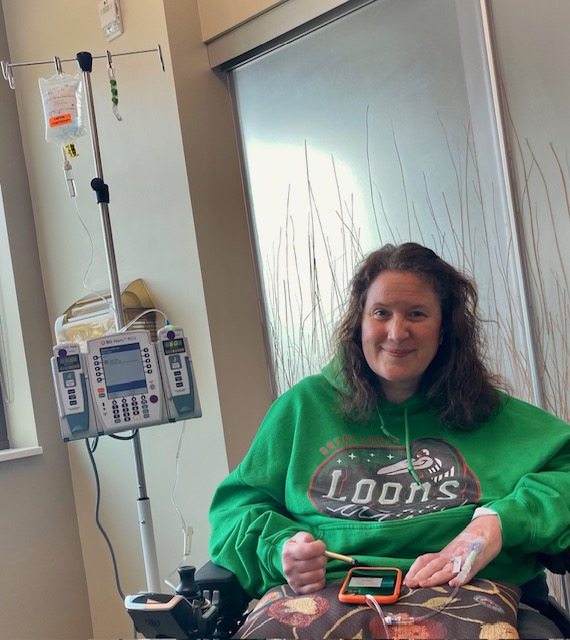
The hardest part of my Multiple Sclerosis Rituxan infusion isn’t the struggle to find a plump vein for an IV placement, or the five hours Dan and I spend in the infusion center, or even the fatigue that follows.
The hardest part is the dose of Solu-Medrol that the nurses give me before my treatment begins.

Because these steroids make me feel amazing.
I accept that the steroids are part of the deal when I receive my disease-modifying treatment twice each year. Solu-Medrol protects me from adverse reactions during my infusion and supports the treatment that I hope will slow the progression and severity of my MS. I take steroids knowing they will lift me up and then let me fall. This isn’t because I enjoy the fall. It’s because I am committed to the long game—a future with Dan that, fingers crossed, will not include MS.
When my body remembers me
Within hours, my body remembers something it hasn’t felt since my last treatment six months ago. My joints loosen. My arthritis quiets. My muscles cooperate.
When Dan transfers me, I stand more easily. I’m solid, almost confident. There’s less hesitation, less bracing for what might fail. I feel strong for a brief, intoxicating stretch of time. Capable. Almost unstoppable.
It is wonderful. But it’s also temporary, and I know that.
About 72 hours later, the borrowed strength slips away.
Standing becomes harder again. Transfers take more effort. My joints ache, and my muscles protest. My body returns to its familiar limits, and I am left holding the memory of how things used to work.
The cruelest part isn’t the pain. It’s the contrast.
The steroids do more than reduce the inflammation. They reveal a version of me that still exists somewhere inside my body. They show me what’s possible, and then quietly close the door behind them. There’s no gentle transition. No easing back into reality.
Just poof! The spell breaks.
Dealing with the whiplash
I mean, what choice do I have?
Living with MS for the past 27 years has taught me that medicine can be both mercy and heartbreak. Sometimes the same drug that helps me also reminds me of what I’ve lost. Sometimes hope comes with a countdown clock.
That emotional whiplash—the rise, the fall, the adjustment—is rarely discussed. But it’s real. And it’s heavy.
Still, I show up.
I endure the emotional extremes. I grieve the temporary strength and adjust to the body I must live in now. I recalibrate my expectations and let go of what was granted to me for 72 short hours.
Not because it’s easy, but because my life is worth fighting for, even when that fight means letting go of something that felt so good.
Source: acoupletakesonms.com