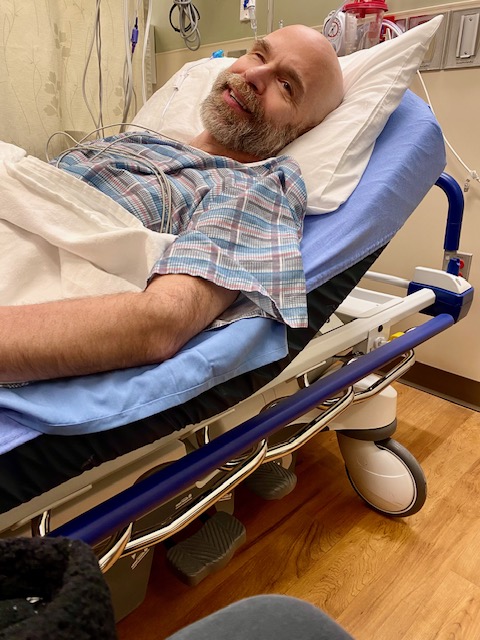
Today marks nine days since Dan’s hernia surgery.
From my perspective, he is healing like a champ. Each day he is a little steadier, a little stronger, and a little more himself. His pain is easing and watching his body recover has been a genuine relief.
And still, this week has been about more than Dan healing from his surgery.

When you live with Multiple Sclerosis, your life typically runs on a carefully planned schedule. Dan and I know how to navigate fatigue, uncertainty, and the choreography of care. Adding surgery to that mix didn’t just slow things down; it shifted our daily balance and routine.
One of our biggest challenges has centered around transfers into and out of my power wheelchair. You know: the trips to the toilet, into the shower, or into bed.
These are the transfers that Dan and I have mastered over our two decades of marriage. Yes, this involves me standing briefly so I can pivot-transfer, but it always depends on Dan’s strength to lift me to standing.
No one else has the strength or skill to singlehandedly do what he does to make this happen for me anymore.
So when Dan was ordered by his surgeon not to lift anything over 10 pounds for the six weeks following his surgery, that put the pressure on us to secure caregivers who could cover for what Dan has done for me all these years.
The craft of transfers and the challenges they carry
Fortunately, we have equipment like a Hoyer lift and a sit-to-stand to make these transfers possible for properly trained caregivers.
With Dan unable to help, my caregivers face pressure to transfer me. Pressure to make bathroom transfers quick and frequent, due to my pesky neurogenic bladder, thanks MS. And sit-to-stand transfers put more strain on my arms and shoulders.
The pain is real and intense.
I don’t share that to complain, but to explain that this is part of Dan’s recovery I’m living with.

It is also where the importance of support becomes unmistakably clear.
Dan feels for me and is sympathetic to my pain, but we could not be navigating this recovery without my caregiver, Jen. Her strength, skill, steadiness, and deep understanding of Dan and my reality have made a profound difference.
Emotionally, there is also another layer.
Dan instinctively wants to help me. He wants to step in when caregivers struggle with my transfers. But he can’t do anything, not without risking his own recovery.
So, we find ourselves holding back for each other’s sake, both aware of our limits, both wanting to protect one another. That restraint is its own form of care.
Because Jen isn’t available to fill all shifts, seven days a week, for the six weeks of Dan’s recovery, this week required meeting several new caregivers. This meant sacrificing more of my personal privacy. But hey, that’s life with a chronic illness, right?
It also brought a familiar kind of tiredness—tired from meeting new people, tired of telling diagnosis stories, tired of teaching how to use the equipment so I don’t get hurt. I’m so tired, and once again, that’s life with a chronic illness.
Five more weeks to go
Tired but thankful at the same time. Grateful for the caregivers’ care and for their wanting to know more about Dan and me. It’s that usual balance.
Nine days later, Dan continues to heal beautifully. I continue to adapt and accept help.
And the truth is, we still have five more weeks to go.
Five more weeks of healing, pacing ourselves, and hoping nothing tips the balance too far. It’s a vulnerable season, and we’re meeting it with honesty, support, and as much grace as we can muster.
We’re not there yet. But we are already looking ahead to week six and the return of a balance that feels a little more like home.
Source: acoupletakesonms.com