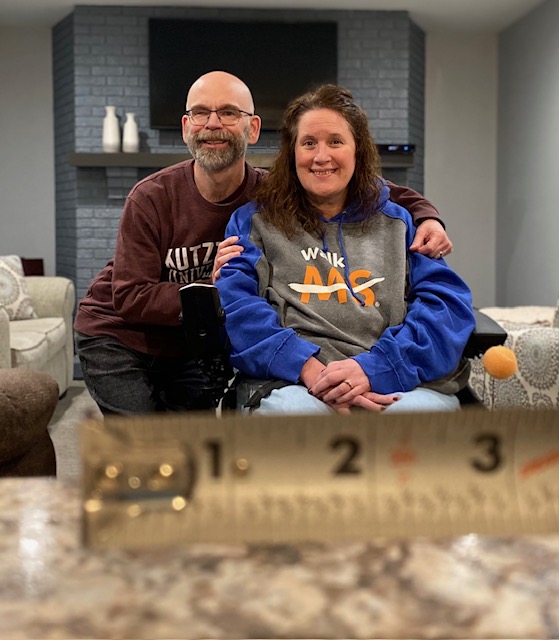
Three inches is roughly the width of a standard smartphone.
Not a big deal, right?
Sure, three inches is somewhat insignificant, that is, until you start talking about surgery and a caregiving relationship.
It. Is. Monumental.
That’s the length of the incision across my lower abdomen. A permanent mark left behind by inguinal hernia surgery that, for six weeks, changed nearly everything about how Jennifer and I move through daily life as caregivers for each other while living with Multiple Sclerosis.

It’s as though this particular incision created an inguinal interruption of sorts in the caregiving choreography we’ve spent more than 20 years learning together.
My recovery limits me from lifting anything over 20 pounds for 42 days, which, as Jennifer has previously written about, forced us to rethink routines that once felt automatic. Tasks that once took seconds required planning. Our energy became something to budget carefully rather than spend freely.
Our rhythm didn’t stop, but it changed drastically.
When the Dance Changes
For years, Jennifer and I have described our caregiving as choreography. It’s a daily dance we’ve shaped together through timing, trust, fatigue, and adaptation.
Living and caregiving with Multiple Sclerosis means we’ve learned those steps gradually. Sometimes it’s graceful. Other times it’s dangerous or all kinds of awkward. But it’s always been together.
This season of recovery required improvisation and learning a new kind of choreography. With new caregivers standing in for me. Yes, we are so blessed and grateful that longtime caregiver Jenn has risen to the task to take on more and additional caregivers have stepped in to cover some shifts.
Some days, caregiving has looked different because I physically can’t do what I normally would. On other days, it meant talking through tasks rather than doing them automatically. Sometimes it meant slowing down enough to recognize what truly mattered in the moment and letting the rest wait.
These adjustments aren’t necessarily dramatic. But they are needed and are totally different from what we’re used to in our caregiving relationship.
Opening the MS genius kit again
When I recently wrote an MS Focus Magazine essay about finding my moments of MS genius, I shared a memory from my Cub Scouts days. You can read it here: Find your moments of MS genius. It was a small moment that taught me creativity often matters more than perfection. At the time, it didn’t feel like a life lesson. It just felt like figuring something out.
Living with MS has a way of turning those small lessons into essential ones.
That’s where the idea of MS genius comes from. It’s not brilliance in the traditional sense, but the quiet problem-solving that happens when life forces you to adapt.
My surgery recovery reminded Jennifer and me of that lesson.
During the weeks after surgery, our “genius kit” opened in familiar ways. We adapted how we moved through the house. We adjusted expectations for what a productive day looked like. We leaned more intentionally into communication and patience both with each other and with ourselves.
Our roles didn’t reverse. They shifted.
Jennifer’s flexibility and steady encouragement have become even more visible, reminding me that caregiving choreography is never one-directional. It’s a partnership.
The three-inch scar across my abdomen will fade over time, but the lessons from this interruption likely won’t. They’ve become part of the growing collection of adjustments, insights, and small problem-solving moments that make up our version of MS genius.
Our caregiving choreography looks different right now. It’s slower, more intentional, and, yes, occasionally clumsy. But it’s still ours, and we are still moving forward together.
We’re just moving to a different kind of beat.
Source: acoupletakesonms.com