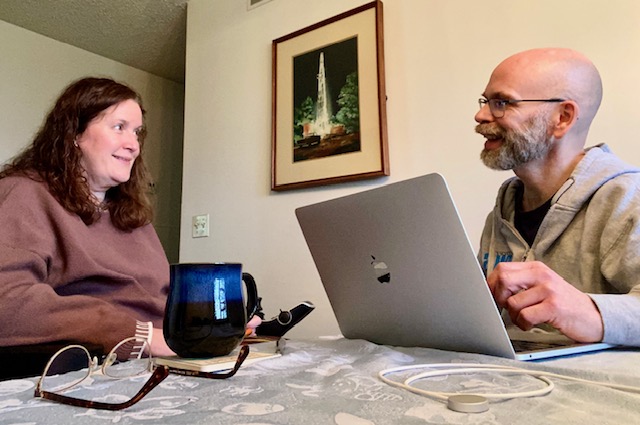
There are moments when living with Multiple Sclerosis feels like a series of calculations between what we can afford, what can wait, and what simply cannot happen at all.
Dan recently faced one of those moments when he needed hernia surgery. It wasn’t optional, and it wasn’t related to his MS.
But like so many medical decisions, it came with a price tag that forced us to pause. Not because of the care itself, but because of the money it required before the surgery could even happen.
Even with insurance, he was still asked to pay thousands of dollars upfront.

Yes, we made it work. But Dan and I couldn’t ignore the bigger question: what happens to people who can’t? What happens when necessary care clashes with financial reality?
That experience led me to encourage Dan to share his story when our MS Director of Advocacy, Anna Meyer, reached out to activists about submitting testimony for a Michigan House Health Policy Committee hearing.
The committee was reviewing Michigan Senate Bills 449 – 451, legislation that would require hospitals to create financial assistance programs and limit how medical debt is reported to credit agencies.
What followed wasn’t just about one procedure. It was about a reality many people are quietly living every day.
For many people living with Multiple Sclerosis, this kind of financial strain isn’t unusual. It’s part of a much larger reality tied to the cost of chronic illness.
This is the testimony he submitted:
To Chair VanderWall and members of the House Health Policy Committee,
My name is Dan Digmann, and I live in Michigan within the districts of State Senator Roger Hauck and State Representative Jerry Neyer. As someone living with Multiple Sclerosis—a chronic and often costly disease—I am writing in support of Senate Bills 449 – 451 and House Bills 5254 – 5255, which would require hospitals to implement financial assistance programs and prohibit medical debt from negatively impacting consumer credit reports.
Earlier this year, I underwent hernia surgery. Although I have health insurance through my employer, I still was required to pay $4,000 out of pocket before the procedure could happen. Like many people, I did not have that amount readily available. To move forward with necessary care, I had to put the expense on a credit card and transfer the balance to an interest-free card, hoping to pay it down before interest begins.
While this expense was not directly related to MS, it reflects a broader reality. Living with a chronic condition already brings ongoing and unpredictable medical costs, from medications to specialist care. Taking on unexpected debt for one procedure reduces my ability to manage future healthcare needs. It creates a compounding effect, where one necessary decision today can make the next one harder or impossible.
I was fortunate to have some time to plan for this cost. Many people do not. If this had been an emergency, the financial pressure and the consequences would have been even greater.
Medical debt is not the result of poor financial choices. It often is the result of doing exactly what patients are supposed to do: seeking care when it is needed. When that debt affects a person’s credit, the consequences extend far beyond healthcare, impacting financial stability, housing, and opportunity.
Legislation like Senate Bills 449 – 451 and House Bills 5254 – 5255 is essential because it recognizes this reality. Requiring financial assistance programs and preventing the use of medical debt in credit reporting are practical steps to protect individuals and families from long-term harm caused by medical necessity. If I had been in a situation where financial assistance, like that outlined in SB 449-451, had been available, I could have avoided taking on not only medical debt, but standard debt.
Thank you for your time and consideration.
Sincerely,
Dan Digmann
Moving forward in controlling medical debt
Dan and I know that we are not alone in this experience. In fact, Anna also submitted a letter of testimony, as did our friend and fellow Michigan MS activist Fox Rigney. We also just had a conversation about affordable healthcare in our podcast episode with MS activist Briana Landis.
Too many people are carrying the weight of medical debt while already carrying the weight of illness, recovery, and uncertainty. Sharing Dan’s letter is important to us because, sadly, stories like his happen every day.
Our hope is that by speaking up and by supporting legislation like this, we can help create a future where living with Multiple Sclerosis doesn’t also mean living with overwhelming medical debt.
Visit the Become an MS Activist website to learn how to get involved in MS advocacy through the National Multiple Sclerosis Society.
The post The price of healing should not be debt appeared first on A Couple Takes on MS.
Source: acoupletakesonms.com