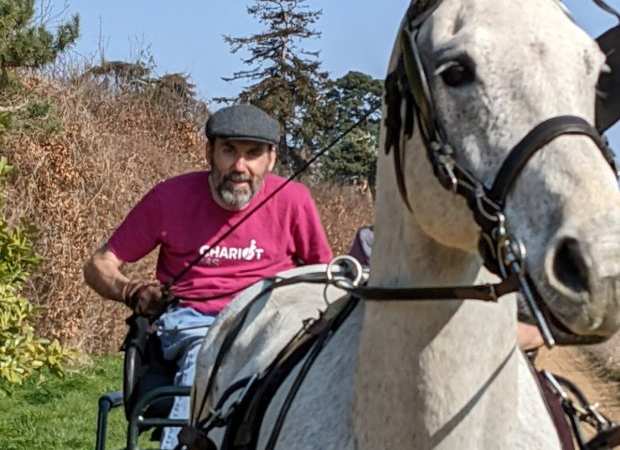
Some might say I’ve been a bit absent from this forum, and it’s true. However, plenty of work has been done by a team so large there wasn’t enough space on the latest abstract submission to MSToronto2026 to include even the most involved, since there is a cap at 40 co-authors. Taken together, literally hundreds of healthcare and other professionals and above all – people with advanced MS are members of Team ChariotMS (NCT04695080).

We’re writing year 8 (eight) since our submission to the NIHR, generously funding the trial since 2020, supported by MS Society UK, US National MS Society, Barts Charity and our industry partner, Merck Healthcare.
So, where are we? We’ve survived COVID and a massive associated delay of the trial; were granted a funded(!) extension of 21 months and are now looking towards the finishing line(s): Last Participant Last Visit (LPLV) in January 2027, data lock three months later, and all going (very) well presentation of results at ECTRIMS 2027 !
We slightly over-recruited – 204 of 200 planned – people with advanced MS. No less than 109 have by now completed all visits. So, it’s really looking up. However, one concern is that we might lose too many participants for the analysis to have sufficient statistical power to produce a definitive result. So, whilst it’s overall looking good, I’d encourage all those still due to complete their final few visits to hang in there and stay on to that precious visit 8 (end of trial). Don’t lose faith or momentum – People across the Globe dependent on wheelchairs due to their MS (and/or further assistance) rely on you to roll down the final straight, to the finishing line and a robust result.
There is certainly an air of optimism among participants and the teams involved, not least against the backdrop of the positive outcome of the O’HAND trial. Here the drug was ocrelizumab, reducing the risk of losing upper limb function by over 40%, but the population was somewhat different from ChariotMS. Only people with primary progressive MS were included, there was an upper age limit of 65 years at enrolment, and there were limits on disease duration.
By contrast, ChariotMS included people with “any” type of progressive MS (primary & secondary), we focussed entirely on people with an EDSS of 6.5-8.5 (3.0-8.0 in O’HAND). There was no upper age limit for inclusion, and neither a limit on disease duration. ChariotMS is very much a co-production between people with MS and clinicians, a true “community trial”, but also with a higher risk of failure compared to O’HAND.
However, if (i) our length-dependent hypothesis is correct, (i) inflammation plays a role throughout MS, and (iii) this inflammation drives deteriorating upper limb/hand function, we stand a reasonable chance to detect an effect of cladribine, as a CNS penetrant immunotherapy, to slow or halt advanced MS. Let’s see!
We have further ideas for ChariotMS – an extension study called “ChariotMSX” – more about this in a few days; I need your views !
Disclaimer: I am the Chief Investigator of ChariotMS.
Support: ChariotMS (17/145/09) is funded by the Efficacy and Mechanism Evaluation (EME) Programme, an MRC and NIHR partnership. The views expressed here are those of the authors and not necessarily those of the MRC, NIHR, or the Department of Health and Social Care. ChariotMS is co-funded by the MS Society UK, National MS Society (US), Barts Charity and Merck (CrossRef Funder ID:10.13039/100009945).
Source: multiple-sclerosis-research.org