This is work from Ester Valero Hernandez and it is her first taste of ECTRIMS and is the talented student of ProfAngry.
People have said that they have got abit bored on me posting on anti-CD20. It is the most used class of high efficacy treatments, but a lot also relates to our work. So does this presentation.
Natalizumab study
It sort of started with the ATTACK-MS trial. This is a trial which gives people the option to start treatment within 14 days of onset of their first ever symptom of MS. Part of the trial asks if it is possible for this to happen within the NHS and a second part is examining if there is repair if you shut down the immune response quickly. This is an on going blinded study but I am pleased to say the trial is a success because it is indeed possible to get people on treatment within this time frame. So well done the GPs and A&E teams within the NHS.
You have a neurological event and you will be referred to hospital where you have a scan….if it looks like MS you will then see a neurologist who will give a tentative diagnosis and you will be offered treatment as part of the tiral. In the UK, natalizumab would currently not be an option but the NHS has given dispensation for this to occur and if the people want to stay on natalizumab they can or they can switch to any drug of choice after the six month study. Natalizumab was selected because it should have a rapid onset of treatment effect and it is also reversible if the diagnosis subsequently and unlikely turns out to be wrong. The main trial sites are London but the team will support transport costs to get people to London so check out the ATTACK-MS contact the team for details. Noting you have to be able to be on treatment within 14 days of your first onset of signs Email: bartshealth.attackms@nhs.net.
Natalizumab for the Treatment of People With Inflammatory Demyelination Suggestive of Multiple Sclerosis, or Definite Multiple Sclerosis, at First Presentation (AttackMS) (AttackMS).
Trial NCT05418010 at clinicaltrials.gov
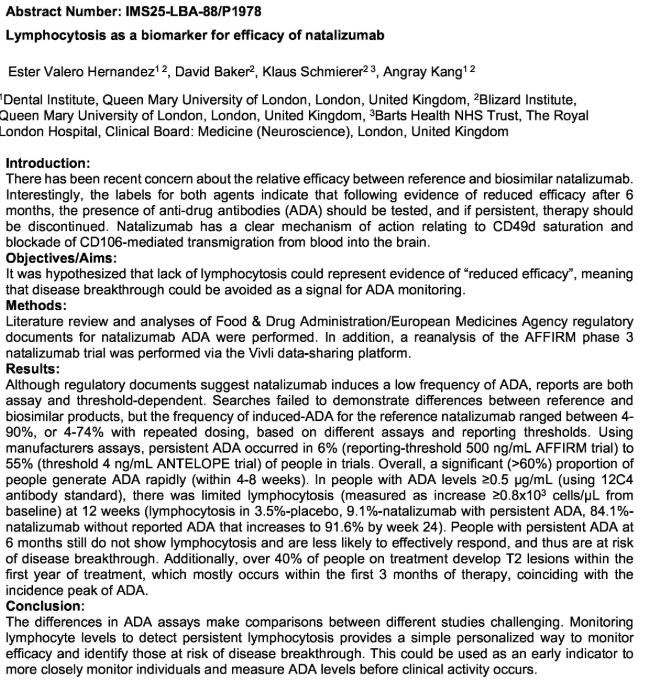
As another part of the project. ProfAngry has been trying to make natalizumab use safer and he invented a test to see if you have anti-drug antibodies (ADA) that can stop the drugs from working. We know that they occur in about 10% of people on natalizumab and in about 6% of people they block function. The drug label says that if you have disease breakthrough or infusion reactions after 6 months of treatment you can test for the ADA and if they are persistent 6 weeks later consider switching. Why wait for 6 month?.
However one problem to this is that most neuros do not have easy access to the ADA test. So ProfA has invented tests for all MS antibodies and more. Anyway ProfA invented his own the test and Ester showed it worked and could pick out people who had ADA responses.. Our friends from Wales (Welsh Neuroscience Bank in Cardiff) sent us some samples to work this out. However whilst reasearching this, biosimilar natalizumab appeared and here about 80% had an ADA response reported in the trial report. It turned out that also 80% on the original natalizumab also had an ADA response. So how come it says only 10% of people get ADA in the Summary of Product characteristics?….It is all based on selective reporting and the assay you use to detect the response. The level was set at a clinically important level, which was patented. The other was reported as a detection level about 100 times lower than the suggested important level when the drug will not work. Importantly we found a regulatory document where we could see that the ADA were being produced within 4 weeks of initial drug delivery and peaking at 8-12 weeks and this was evident in about a mean of 60% of people. If you only get one injection of natalizumab about 90% of people made ADA. By having multiple doses the level of detectable ADA drops in most individuals Anyway during this review we found a paper with the disease course of an individual who developed anti-drug antibodies and their features matched a person who was also failing natalizumab. It seemed they never really responded in the first place. So it looked like some people get drug they rapidly make an ADA response and it become persistent and so people are probably never responding property and so with time they may relapse.
We have previously shown with alemtuzumab and ocrelizumab that a biomarker for drug activity is a a drop in lymphocyte levels. If a depleting drug is working it should deplete. If people develop an important level of anti-drug antibodies then the drugs do not cause depletion. Check the levels of the white cells after depletion and you know if it is working…Simples
Natalizumab works by stopping white blood cells exiting the blood and so if the drug is working there should be an increase in lymphocytes. Could this be a marker for drug activity. In the individual we found we found that lack of an increase was evident pretty quickly, before 6 months. So we thought we could look for that but it would be a lot of effort and thought this has already been done in the clinical trials were there are lymphocyte counts and ADA have been measured. We could see that white cell counts increased in people on drug but was this affected by people with ADA. So we went to Vivli org (a trial data request platform that Biogen had signed up to, They provide access to their trial data which is viewable on the vivli platform) and requested access to the Biogen clinical trial reported in 2006 (Polman et al). We have used this platform before and Biogen were very kind to produce the data in a way that was very easy for us to access. So the analysis was pretty quick.
In people who made ADA i.e. at clinically important levels we found that white blood cells did not or showed minor increases within 3 months of treatment. Some people stop making important levels and the white cells increase whereas others the ADA persist and white cells do not increase and this has a risk of failure. So by looking at white blood cell numbers you can get a clue of who is and who is not responding to natalizumab and you have the potential to see who is failing treatment before they actually have an attack. A simple thing that can be done where every you are and helps if you do not have access to the ADA testing or helps you to rationalised who should tested. In trials seeing white cells could unblind you to treatment, but we are saying it is something that can easily be part of routine practise at minimal cost compared to giving ineffective antibodies.
This study was done using available data.

COI: Attack-MS was supported by Biogen and now by Sandoz.
Elements of this study are based on research using data from data contributor Biogen that has been made available through Vivli, Inc. Vivli has not contributed to or approved, and is not in any way responsible for, the contents of this work. The support from the Medical Research Council (EVH) and National Institute of Health and Care Research (ASK) is acknowledge.
Source: multiple-sclerosis-research.org