Patient and public involvement (PPI) has been the mantra in grant review and research funding for years. It is said that “People living with a health condition are often in a better position to know what questions remain unanswered about their treatment or condition, and what research would most likely improve their quality of life”
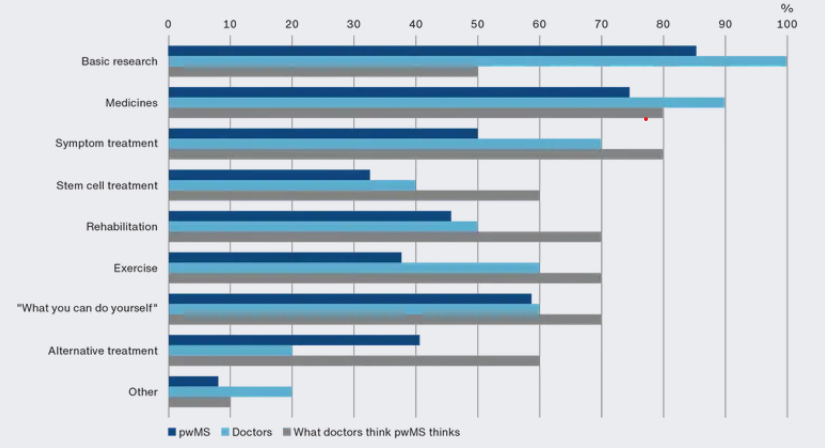
Here they look at Doctors and patient views of where research should focus you can see that people with MS may be more aligned than Doctors think. However, it stands to reason that people will focus on things that will seem to offer benefit. However this can mean that focus is placed on pop-science and millions can be flushed. I have seen this happen over and over again.

From the paper below
We have the James Lind Alliance
3. Which treatments are effective for fatigue in people with MS?
4,How can people with MS be best supported to self-manage their condition?
6. Is Vitamin D supplementation an effective disease modifying treatment for MS?
7. Which treatments are effective to improve mobility for people with MS?
8.Which treatments are effective to improve cognition in people with MS?
9.Which treatments are effective for pain in people with MS?
10. Is physiotherapy effective in reducing disability in people with MS?
These have been around for years and one can ask what progress has been made on any questions…we are only heard last week about need for more effective treatment of fatigue, so of the questions one could say why bother, this is the realm of pharmaland to answer the questions and for some one could say I can give a fair answer….the answer to 6 could have been “No” at the time the questions were raised…but how much was funneled into trials?
I think this is involvement is easier to link to clinical research but some basic science research goes over my head and is perhaps rather esoteric, but I am sure people can be manipulated to think stuff is more matured and supportable and worthy of funding than it should be. I think that there is seldom sufficient space to explain the science properly in space provided in grants for PPI. What do you think about PPI.Are you involved?
Hansen JS, Rasmussen PV, Finnerup NB, Svandsen KB. Patient’s and researcher’s perspectives on patient involvement in research in multiple sclerosis. Dan Med J. 2025; 72:A04250351.
Introduction: Patient involvement has increased in recent years and has been requested by both patients and patient organisations, e.g., in relation to prioritising research questions and outcomes. However, when planning new research, patients are not automatically involved.
Methods: This study aimed to describe and elaborate on patient involvement in research in multiple sclerosis (MS) from both patients’ and researchers’ perspectives.
Results: In total, 141 patients with (pw) MS and ten doctors responded to the questionnaires. Patient involvement was considered important by pwMS, mean score 8.9, standard deviation 1.4 (min. 5-max 10) on a 0-10 numeric rating scale (0 = no importance, 10 = very important), and 43% of pwMS answered that they could imagine themselves being a co-researcher.
Conclusions: Patient involvement is considered important for pwMS. This study may serve as a source of inspiration or a guideline for future studies using patient involvement
Source: multiple-sclerosis-research.org