Yesterday I did a post on Tysabri and Tyruko and we had a few posts saying the biosimilar was not the same. Some have taken to the media to aire this view, but there have been many other me-toos been introduced to the MS word.
So what do you think about this?
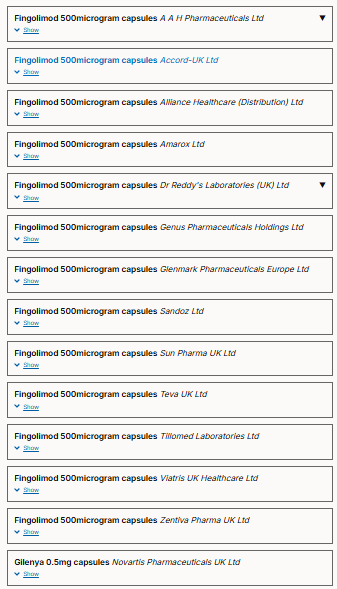
We have fingolimod and generic fingolimod. This is from the British National Formulary. As you can see there are over a dozen.

A biological generic is called a biosimilar because the manufacturing process of each agent is not defined and so there are subtle differences. For chemicals the structure is defined and so whilst there may be different ways of getting to product the purity is all that is the potential difference and as this is defined they are essentially very similar and so you really are essentially getting the same product wrapped in different cardboard.
However are they completely identical?
According to this study maybe not but are they all inferior of was their a duff batch?. I don’t know. However the paper below would be music to the ears of the ogrinal manufacturer…..In many places there is brand loyalty…If it ain’t broke why fix i?….but NICE is trying to save a buck in poundland Britain.
However, if you notice something wrong let your medical team know.
Patel MA, Punnen TG, Shan KS, McCreary MC, Wright CM, Munoz SB, Hardeman P, Burgess KW, Greenberg BM, Horton LA, Sguigna PV, Tardo LM, Stüve O, Okuda DT. Mult Scler. 2026: 13524585251401404. doi: 10.1177/13524585251401404.
Background: Gilenya® (fingolimod), a sphingosine-1-receptor agonist, is an effective treatment for multiple sclerosis (MS). However, increased relapse activity has been observed after transitioning to generic fingolimod despite prior prolonged disease stability.
Objective: To quantify the clinical and radiological impact of transitioning from Gilenya® to generic fingolimod in people with MS (PwMS).
Methods: Retrospective data were evaluated from a single tertiary MS care center. Time to magnetic resonance imaging (MRI) activity and clinical relapse was assessed during Gilenya® and generic fingolimod treatment. Differences in absolute lymphocyte count (ALC) and side effects were also measured by treatment group.
Results: The cohort included 88 PwMS (71 female; 76 White, mean age when starting Gilenya® was 39.6 years (standard deviation (SD) = 10.6 years), and mean age when starting generic fingolimod was 46.9 years (SD = 11.2 years)). A shorter time to MRI activity (p = 0.0026) and time to relapse (p = 0.0027) was observed during generic fingolimod treatment. The ALC increased by 8.81% after generic fingolimod treatment, relative to Gilenya® (95% CI = (2.00%, 16.08%), p = 0.01), with an intersubject variability of 1.97%. A 2.45-fold increase in side effects was observed with generic fingolimod relative to Gilenya® (95% CI = (1.38, 4.36), p = 0.002).
Conclusion: Measures of disease stability appear less optimal with generic fingolimod based on serological, clinical, and radiological measures.
Source: multiple-sclerosis-research.org