Natalizumab is a migration inhibitor that works because it blocks lymphocytes and monocytes from migrating into the CNS and other tissues. It has been given as an intravenous infusion and more recently, as the patent runs out, as an injection under the skin. These both used to be given in hospital, but the latter may be given at home in some instances.
One of the risks of antibodies and other drugs that are proteins is the development of infusion-related reactions. These are common with drugs that burst open cells to kill them as the contents cause the infusion reactions, However, natalizumab is not really a killer, but a blocker. The infusion reactions are limited by giving pre-dose anti-histamines and steroids and by giving lower doses to start wih and slower infusions.
One of the causes of infusion reactions can be anti-drug antibodies and so I was interested in something they said here. The take home message was that you probably don’t need to wait to see if the infusions reactions occur in people who are stable
Bafrani MA, Ahmadi NS, Idjadi FZ, Bordbar S, Jahani S, Montazeri R, Zonouzi SK, Lapevandani MM, Ebadi Z, Navardi S, Heidari H, Azimi A, Moghadasi AN, Sahraian MA. Post-infusion observation of patients with multiple sclerosis receiving natalizumab: Is it necessary? Mult Scler Relat Disord. 2026 Jan 13;107:106995.
Background/objective: Natalizumab (Tysabri ®), the first monoclonal antibody approved for treatment of relapsing-remitting Multiple Sclerosis (RRMS), can significantly reduce exacerbations and active brain lesions. Due to concerns on infusion-related reactions (IRRs) patients should be observed during the infusions and one hour after the completion of the infusions for signs and symptoms of hypersensitivity reactions, especially in the first 12 doses. This study was conducted to see if one-hour post-infusion observation is necessary in all patients receiving natalizumab or can be wavied in some stable patients.
Method: In this cross-sectional study, one-hour post-infusion observation was not conducted in patients who had previously received three doses of natalizumab without any history of moderate to severe or life-threatening IRRs based on the Common Terminology Criteria for Adverse Events (CTCAE) definition. Patient demographics and clinical characteristics were recorded by a trained physician in a questionnaire coupled with an emergency hotline provided for IRRs. In case of a modere to sever or life-threatening reaction during the ifusion the patient excluded from the study. Phone follow-up was done after an hour by the same medical doctor.
Result: 424 patients with MS were enrolled in this study. Fatigue (10.8%), headache (4.5%), and cough (2.8%) were the most prevalent symptoms after 1 hour from the infusions. No life-threatening complications happened for the patients. There was no significant relationship between age, gender, the interval between doses, the number of total infusions, and disease duration with the incidence of side effects.
Conclusion: Early discharge without one hour post-infusion monitoring can be considered for patients without any moderate to sever adverse reaction in the fisrt three infusion of natalizumab.This sterategy may reduce the costs and save the time of infusion for these patients.
Here they didn’t see any life threatening adverse reactions and thought people could be sent home with a phone call.
They say “
•According to current guidelines, patients with MS receiving natalizumab should be monitored during the infusion and for one hour afterward to identify and manage potential infusion-related reactions, which, although rare, can occasionally be serious.
•One hour post infusion observation is not necessary for patients who had no infusion related reaction during the last 12 infusions according to the latest summery of product informations.
•Our study demonstrated that one hour post infusion observation can be waived after 3 natalizumab consecutive infusions provided that the patient had no moderate or sever reaction in previous infusions.
•This infusion sterategy may decrease the cost and save the time for both patients and health care profissionals.
Now remember I am not a doctor and not going to comment on this study, as I am sure you healthcare professionals have protocols on how they deal with infusion but I did look on the European Medicines agency website and it states
“After dilution (see section 6.6), the infusion is to be administered over approximately 1 hour, and patients are to be observed during the infusion and for 1 hour after the completion of the infusion for signs and symptoms of hypersensitivity reactions. After the first 12 intravenous Tysabri doses, patients should continue to be observed during infusion. If the patients have not experienced any infusion reactions, the post dose observation time may be reduced or removed according to clinical judgement”.
However I hadn’t noticed why infusions over the first 12 weeks were considered to be important and this what prompted me to write here. It has dawned on me perhaps why and recently we wrote a paper following studying documents on the EMA and FDA websites and also seeing stuff that wasn’t common knowledge. That prompted us to request access to data from the pivotal trials of natalizumab reference and biosimilar antibodies. One was open and helpful and gave us access to the information. This was supplied via a platform run by a company called Vivli and the data was supplied by the natalizumab manufacturer to report individual data is a helpful way. They were transparent and we had frank discussions with them and they want us to report the data….the other played us along making the right noises for 18 months only to say no!…Shame on them. It makes me think that as you volunteer for these studies and the regulators want transparency, I think that to get a licence the whole data set should be deposited with the regulators before they approve a drug for sale. The regulators can ensure people getting access can deal with it responsibly. This way the data can be rapidly investigated and not drip-fed, or ingnored by, the marketeers in a way that make things sound like cherry pie.
Indeed Vivli write to us to ask about public disclosure of the information.
So here we go again, it was reported and the paper is ready to fly
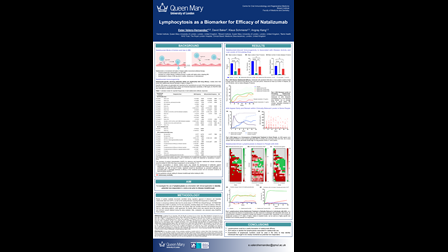
Ester Valero HernandezPOSTER ID P1978 Lymphocytosis as a biomarker for efficacy of natalizumab. TopicLate Breaking Abstracts ECTRIMS 2025

Lymphocytosis as a biomarker for efficacy of natalizumab
Multiple sclerosis Journal 2015 31(suppl 3) pg 1348-1346
Ester Valero Hernandez1,2, David Baker2, Klaus Schmierer2,3, Angray Kang1,2
1Dental Institute, Queen Mary University of London, London, United Kingdom, 2Blizard Institute, Queen Mary University of London, London, United Kingdom, 3Barts Health NHS Trust, The Royal London Hospital, Clinical Board: Medicine (Neuroscience), London, United Kingdom
Introduction: There has been recent concern about the relative efficacy between reference and biosimilar natalizumab. Interestingly, the labels for both agents indicate that following evidence of reduced efficacy after 6 months, the presence of anti-drug antibodies (ADA) should be tested, and if persistent, therapy should be discontinued. Natalizumab has a clear mechanism of action relating to CD49d saturation and blockade of CD106-mediated transmigration from blood into the brain.
Objectives/Aims: It was hypothesized that lack of lymphocytosis could represent evidence of “reduced efficacy”, meaning that disease breakthrough could be avoided as a signal for ADA monitoring.
Methods: Literature review and analyses of Food & Drug Administration/European Medicines Agency regulatory documents for natalizumab ADA were performed. In addition, a reanalysis of the AFFIRM phase 3 natalizumab trial was performed via the Vivli data-sharing platform.
Results: Although regulatory documents suggest natalizumab induces a low frequency of ADA, reports are both assay and threshold-dependent. Searches failed to demonstrate differences between reference and biosimilar products, but the frequency of induced-ADA for the reference natalizumab ranged between 4-90%, or 4-74% with repeated dosing, based on different assays and reporting thresholds. Using manufacturers assays, persistent ADA occurred in 6% (reporting-threshold 500 ng/mL AFFIRM trial) to 55% (threshold 4 ng/mL ANTELOPE trial) of people in trials. Overall, a significant (>60%) proportion of people generate ADA rapidly (within 4-8 weeks). In people with ADA levels ⩾0.5 μg/mL (using 12C4 antibody standard), there was limited lymphocytosis (measured as increase ⩾0.8×10³ cells/μL from baseline) at 12 weeks (lymphocytosis in 3.5%-placebo, 9.1%-natalizumab with persistent ADA, 84.1%-natalizumab without reported ADA that increases to 91.6% by week 24). People with persistent ADA at 6 months still do not show lymphocytosis and are less likely to effectively respond, and thus are at risk of disease breakthrough. Additionally, over 40% of people on treatment develop T2 lesions within the first year of treatment, which mostly occurs within the first 3 months of therapy, coinciding with the incidence peak of ADA.
Conclusion: The differences in ADA assays make comparisons between different studies challenging. Monitoring lymphocyte levels to detect persistent lymphocytosis provides a simple personalized way to monitor efficacy and identify those at risk of disease breakthrough. This could be used as an early indicator to more closely monitor individuals and measure ADA levels before clinical activity occurs.
A hypersensitivity is another way of saying an allergic reaction and these are often caused by the generation of anti-drug antibodies. If they are of a certain type and there are high levels of these, they can indeed cause life threatening problems (This is called anaphylaxis or anaphylactoid reactions). In some cases this may cause infusion reactions and if it is very severe it could cause your airways to contract and if you do not get medication immediately you could die. You may have heard of “peanut allergy” and you are aware how severe this could be, it could be like this. Thank fully this is very rare. Anaphylaxis typically occurs in minutes and this is why you need help at hand. When an infusion reaction occurs it can be very frightening, but hospital staff are prepared for it and can deal with it. I know I have watched them do this for my mum. There is also serum sickness causes by anti-drug antibody and the antibody-drug take longer to develop and will be less dangerous.
But why the 12 weeks? It pricked my interest and here is one potential suggestion.
It is reported (Summary of product characteristics in EMA/FDA/MHRA) that anti-natalizumab antibodies only develop in about 10% of people and only about 6% of these become persistent that is a risk factor for treatment failure and the need for switching of treatment following disease development. It also says in the regulatory documents that most people who are destined to become persistently positive do so within the first 12 weeks of treatment. We can confirm this as we have seen the results due to access to the Vivli platform and the trial. Now when natalizumab is injected, it reaches the blood stream in sufficient amounts very quickly to block the binding of CD49d molecule on the white blood cells and this blocks binding to CD106 on blood vessels near areas of inflamed brains. These levels should block white blood cells causing further lesion formation within 24 hours shutting down lesions. That’s the basis for how natalizumab works.
However, why watch of 12 weeks in particular?..
It seems that actually the frequency of anti-drug antibodies occurs in over 80% of people and these can be persistent in up to 55% of people. Now given that persistence of anti-drug antibodies is a reason for switching according to the label/summary of product characteristics…this is perhaps relevant. Because this means what you do depends on the assay used to measure anti-drug antibodies. It turns out that the level relates to reporting a “functionally-important level” not a level of detection. This latter element is variable depending on what levels your assay detects and the functionally important level is dependent on a standard and an assay that is not widely available and is protected by a patent, yet to expire. The summary of product characteristics need to be looked at.
Anyway, now why 12 weeks?….Well I think it is because people who are going to develop anti-drug responses, do so within the first 12 weeks and so if you were going to have the adverse reactions you would think they occur early.
What I did not appreciated is that the majority of people developing ADA do this within 4-8weeks and that it seems to me that for some people these block the drug working. This means natalizumab does not work within a few hours to stop lesions in some people and for some it probably means the drug is not working effectively for 3-6 months…For some not working at all. This is potentially problematic because remember many people will be switched at 24 months due to risks of PML, so a lot of effort to put people on drugs for a short while.
Why do I think that, well this can be seen by the number of circulating white blood cells (notably the lymphocytes although the increase is probably best seen by looking at B cell numbers as they go above normal levels.) not increasing. If the drug is working well, cells are trapped in the blood and so their number goes up. People may only notice this when it goes above normal levels in most cases this is not the case and this is why B cell counts makes change easier to notice, but if you look in the trial data there is early evidence of relapse and the formation of new and enlarging lesions. One view is that it takes time for agents to work, this is called therapeutic lag and a reason why companies re-baseline. But the other way to look at this, is that the drug is not actually working quickly, because of the anti-drug antibodies, and early on in some people. You have to wait for the level of ADA levels to wane, which they do, so one can see for some people it takes 3 to 6 months for the drug to work effectively. This is one reason why it is suggested in the summary of product characteristics that neuros do not look for them until after 6 months and sadly until after there is disease activity. So there is a significant number of people not receiving in my mind effective treatment. However why make people have disease before you look, when you can get an idea if the drug is active by looking at lymphocyte levels? This is is why trial data should be open, as it allows people to look at it and suggest ways to improve safety.
Disclaimers: These are my opinions and views, I am not a doctor.
Source: multiple-sclerosis-research.org