Kuiper KL, Bogers L, Rip J, van Hasselt Y, Melief MJ, Wierenga-Wolf AF, Klein Kranenbarg RAM, Bindels E, van de Werken HJG, de Beukelaar J, Smets I, Wokke B, Smolders J, van Luijn MM. Integrin β1 Demarks Precursors of Brain-Residing Antibody-Secreting Cells in Multiple Sclerosis. Neurol Neuroimmunol Neuroinflamm. 2026 May;13(3):e200553.
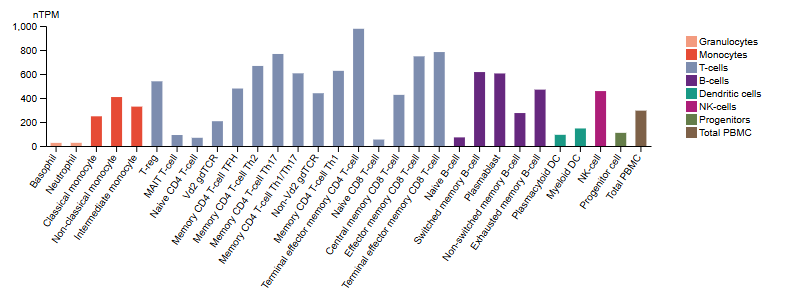
Simple answer is no as Beta one integrin is every where it is a marker that increases on memory T and B cells and is on cells migrating into the CNS that are blocked by natalizumab. This explains why the antibody works in MS. Beta 1 integrin along with alpha 4 integrin are important for cell migration into the inflamed central nervous system…Simples

Data from http://www.proteinaltas.org https://www.proteinatlas.org/ENSG00000150093-ITGB1/single+cell#single_cell_type_summary
Background and objectives: Multiple sclerosis (MS) is characterized by CXCR3+ memory B cells that infiltrate the CNS to mature into antibody-secreting cells (ASCs). It remains elusive how to benefit from this disease hallmark as a prognostic tool. We aimed to uncover markers that reflect B-cell entry and maturation in the CNS and, on that basis, explore associations with response to high-efficacy MS therapies.
Methods: Ex vivo single-cell technologies were applied to blood samples and postmortem CNS suspensions from MS and control donors, either treated or untreated. In addition, in vitro assays were performed on blood samples from healthy individuals to functionally asses B-cell activation, differentiation, and transmigration.
Results: Single-cell RNA sequencing revealed ITGB1 (integrin β1/CD29) as a major discriminator of CXCR3+ memory B cells in blood, which was validated using spectral flow cytometry. CD29+CXCR3+ memory B cells preferentially crossed a brain microvascular endothelial layer and were highly receptive to T-cell help to become ASCs in vitro. In contrast to blood, CD29 and CXCR3 coexpression was restricted to ex vivo ASCs derived from CSF, meninges, and brain tissue of people with MS, which was supported by enhanced CD29 upregulation on in vitro-differentiated ASCs. While CD29 was downregulated on CXCR3+ memory B cells that accumulated in the blood of natalizumab-treated patients, CD29 levels were only reduced on CXCR3+ memory B cells that repopulated in cladribine-treated patients without early disease activity.
Discussion: These findings put forward CD29 as a putative marker on CXCR3+ precursors of CNS-residing ASCs for predicting treatment responses in MS.
Source: multiple-sclerosis-research.org