
‘I didn’t set out to become a caregiver.’
Like a lot of people, I stepped into the role of a caregiver because it was needed. Because it was part of loving someone. Quite honestly, there wasn’t another option.
My wife, Jennifer, lives with Multiple Sclerosis. So do I.
We are grateful for the professional caregiving support Jennifer receives through the MI Choice Medicaid Waiver program. Her caregiver comes each weekday to help with Jennifer’s activities of daily living as I continue working full time. Still, most of what keeps our life moving forward happens at home through me.
This is unpaid family caregiving.
It’s not something that gets announced. It just becomes part of your day. Part of your routine. Part of how you show up.
I didn’t really think much about it. I just assumed this was what you do when you love your spouse. Your parent. Your child.
Over time, though, I’ve started to see caregiving differently.
We tend to think of independence as doing everything on your own. But that’s not what independence looks like for Jennifer and me. In our world, caregiving actually is what makes independence possible.
It’s what helps Jennifer to stay engaged, keep contributing, and to live a full and connected life.
When the system falls short
This shift in my perspective didn’t happen all at once. It became clearer through experience, especially during a recent stretch when I physically couldn’t do what caregiving required of me.
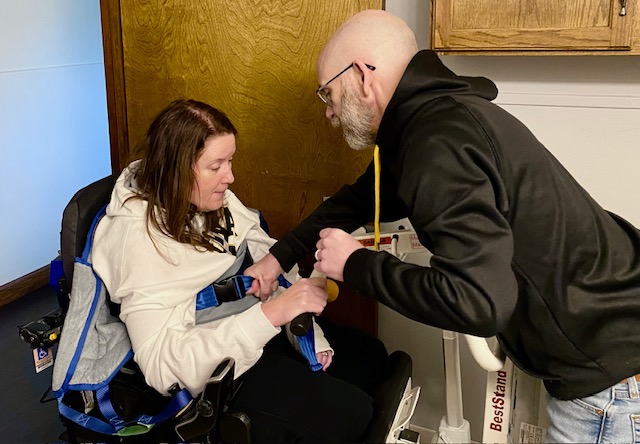
I had hernia surgery in January, and for six weeks, I wasn’t allowed to lift more than 20 pounds. That meant I couldn’t safely help Jennifer with transfers.
We did what we were supposed to do. We requested additional caregiver support. We were grateful for the small increase in hours, but it wasn’t the around-the-clock care that Jennifer receives when I am fully healthy.
Again. Unpaid family caregiving.
Even though we were approved for the additional 10 hours of caregiving each week during my recovery, when caregivers didn’t show up—which happens more often than people might expect—we were left figuring things out in real time.
That experience changed how I think about caregiving. Because in those moments, it became really clear that what looks like a private family responsibility is actually something much bigger.
There are more than 50 million family caregivers in the United States, and most of them are unpaid. Together, they provide an estimated $600 billion in care each year—care that makes it possible for people to remain in their homes and stay connected to their communities. In fact, family caregivers provide the vast majority of long-term care in the United States.
Like Jennifer and me, many of those caregivers are filling in the gaps every single day, adjusting schedules, solving problems, and doing whatever is needed to keep life moving forward. Not because they’re trained for it. Not because they’re paid for it.
But because someone they love needs support.
Recognizing the worth of family caregivers
We often talk about infrastructure in terms of roads, hospitals, or systems that people can see.
Caregiving is infrastructure, too, even if we don’t call it that.
It’s what offers a priceless quality of life that people living with disabilities, chronic illnesses, or age-related needs are looking for to remain in their homes and communities. It’s what holds things together when formal systems fall short.
And yet, most of it happens quietly behind closed doors.
One of the most important things I’ve had to learn is that for as much as caregiving is an act of love, it also is an act of labor.
Yes, both can be true at the same time.
Caregiving means being present for someone you love. It also means lifting, coordinating, advocating, adjusting, and sometimes carrying more than expected.
On average, family caregivers spend nearly 24 hours per week providing care, often on top of full-time jobs and other responsibilities. It’s physical. It’s emotional. It’s constant.
Still, most of it goes unseen.
Recognizing caregiving as work doesn’t take anything away from the love. If anything, it gives a fuller picture of what that love looks like in action.
From the outside, caregiving can look seamless. From the inside, it’s anything but.
It’s unpredictable. It changes day to day. It asks you to balance your responsibilities, your energy, your time, and sometimes your own health, all while still showing up for someone else.
In fact, many caregivers report high levels of stress, and a significant number are managing their own health conditions—don’t forget that I’m navigating MS myself—while providing care.
There isn’t really an “off” switch. It just becomes part of how you move through your life.
The more I’ve lived this, the more I’ve come to believe that our country needs to change the way it views caregiving. Not as something families quietly manage on their own, but as essential work that deserves to be seen, understood, and supported.
After all, caregiving isn’t rare. It’s not something happening somewhere else. It’s happening every day—in homes like Jennifer’s and mine and in homes all around us.
I didn’t set out to become a caregiver. Neither of us did. We set out to show up for each other.
And somewhere along the way, I’ve come to understand that showing up day after day, in ways both big and small, is what makes everything else possible.
The post A caregiver’s perspective on selfless love and unseen labor appeared first on A Couple Takes on MS.
Source: acoupletakesonms.com