Remember stroke management before the HASU and thrombolysis era? It was largely characterised by supportive care, rehabilitation, secondary prevention (aspirin, statins, blood pressure, weight & diabetes control, …). And whilst these measures all remain important, significant gains were made once Alteplase (thrombolysis) was introduced, and subsequently endovascular thrombectomy.
AttackMS is like the “thrombectomy of MS”: Remove acute ischemia caused by a thrombus thereby restore function (stroke). Remove acute inflammation in newly diagnosed MS (including at the stage of CIS), enable repair, and prevent dreaded PIRA.
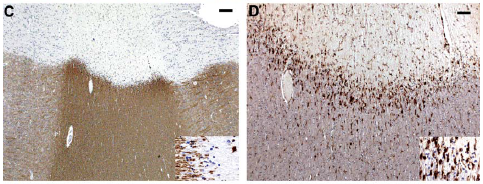
Evidence suggests an association between PIRA and slowly expanding/chronic active lesions/smoldering lesion activity. Check out activated microglia cells, the brown semi-circle at the edge of a demyelinated lesion, on the histology pics C & D below:


These images and graph A are from Frischer, et al. 2015. What the graph illustrates is that Frischer & colleagues found none of these slowly expanding (“smoldering”) lesions at the monosymptomatic (mono = CIS) stage and neither during the (presumably early relapsing [RR]) phase of MS.
Thus, attacking MS at first presentation, using a compound with a proven efficacy & safety record, certainly in the short term, may avoid the emergence of those pesky chronic active lesions and – thus – PIRA.
Now, unless we MRI everyone who turns up in clinic with headache, it is unlikely we will catch a great number of people with MS at the stage of RIS (= radiologically isolated syndrome). AttackMS is therefore a testbed for the closest we can usually get to a powerful, early intervention with potential for wide adoption, provided rapid referral & review pathways can be generated.
Let’s see what the data say – we’re open for recruitment until April 2027. Email bartshealth.attackms@nhs.net if you know somebody who has had first ever symptoms suggestive of MS within the past 14 days.
Is newly diagnosed MS a medical emergency? AttackMS addresses that question.
Disclaimer: I am the Chief Investigator of AttackMS
Support: AttackMS (NCT05418010) is sponsored by Queen Mary University of London and funded by Sandoz (previous funding support came from Biogen).
Source: multiple-sclerosis-research.org